
The Chinese authorities are trying to contain the spread of a dangerous virus that has already killed 18 people.
The Chinese authorities are trying to contain the spread of a dangerous virus that has already killed 18 people. Two cities in Hubei province, which has become the epicentre of the new virus, have been closed for entry and exit, and several more have been restricted from public transport. More than 600 people have been infected with the new coronavirus, which affects the respiratory tract and can be transmitted from person to person. The virus has already penetrated into the USA, Thailand, South Korea, Vietnam and Saudi Arabia. On Wednesday, Chinese authorities decided to quarantine Wuhan city in Hubei province with a population of 11 million people, where the virus was first detected. All roads leading to the city were closed and other transport links were blocked. On Thursday, a similar decision was made for another city in Hubei province, Huangana, which is home to 7 million people. All trains and planes going to Huangangan, as well as intra-city transport, were cancelled. Ezhou stations have been closed and Xiantao and Chibi cities have restricted public transport. "Closing a quarantined city with a population of 11 million is something out of the ordinary," said World Health Organisation (WHO) spokesman Gauden Galea. The WHO is currently discussing whether an international emergency should be declared in response to an outbreak of a new virus.
Experts, however, express doubts about the effectiveness of quarantine in today's world, and the writer David Kuammen, who wrote a book on how animal-transmitted infections can lead to a deadly global epidemic, believes that the emergence of such a coronavirus was predictable.
The first death outside of Wuhan Until recently, all 17 deaths have been recorded in Wuhan, the hotbed of the virus. On Thursday, Chinese authorities reported the first death outside the city of Wuhan. An 80-year-old patient died in hospital Wednesday night in northern Hebei Province. He visited relatives in Wuhan and went to the hospital after returning, where he later died.
New Year's Eve - no celebrations The authorities also decided to cancel all large-scale events in Beijing to celebrate New Year's Eve according to the lunar calendar on January 25 - New Year's mass festivities, including traditional fairs in temples.
Millions of people travel around China during the New Year celebrations. Thousands of Chinese also travel abroad.
In addition, as of January 25, the entrance to the Forbidden City, a palace complex in central Beijing near Tiananmen Square, will be closed.
Wuhan and Huangangan are under blockade. On Friday night, all bus and train routes in Huangan will be suspended. City cafes, restaurants and cinemas will also be closed. People are advised not to leave the city.
Meanwhile, residents of Wuhan, who were instructed not to leave the city the day before, have expressed concern at possible shortages of food and complained about sharp price increases in social networks.
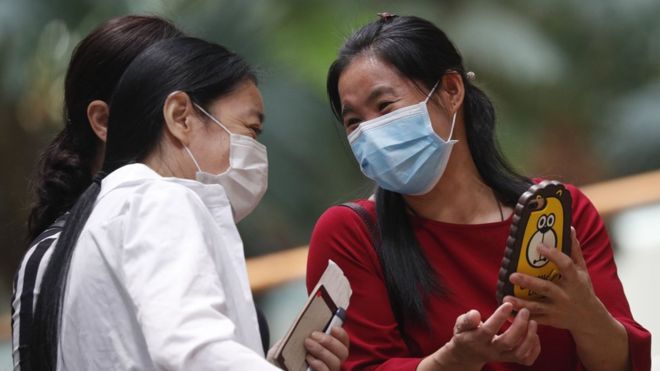
The shelves of many of the city's shops were emptied after the residents began to rush to stock up on food. Townspeople are also actively buying medical masks, the wearing of which has become mandatory.
Right holder of the illustrationAFP Image caption When it was still possible to get out of Wuhan, the temperature was measured before boarding the flight or train. Right holder of the illustration Image caption Wuhana Main Railway Station is closed to passengers on Thursday morning. As of Thursday, all flights from Wuhan, a large and important city with transport and economic connections around the world, have been cancelled. There are direct flights from Wuhan to London, Paris, Dubai and many other cities.
City museums, libraries and theaters are instructed to cancel exhibitions, tours and other public events.
Will the quarantine work? Experts, however, doubt the effectiveness of such measures: it will be difficult to fence off an entire city, the 42nd largest in the world.
"The only way to achieve this, if you are realistic, is to introduce an army to take the city into the ring," says Adam Camradt-Scott, a health expert at the University of Sydney.
"But even if you go for it, where does the line go? Like most modern cities, on the outskirts of Wuhan, it goes to smaller towns and villages," the expert added. World Health Organisation expert Gauden Galea is more direct.
"As far as I know, an attempt to contain the virus in a city of 11 million people is something that is still unknown to science. We can't tell if it will work," he told the Associated Press.
Fears about the spread of the new type of coronavirus have also affected stock markets: Chinese indices lost about 3% on Thursday.
The rightholder of the illustration Image caption Demand for medical masks rose sharply after the outbreak of the epidemic. Right holder of the illustration IMAGES Image caption Wuhan residents rushed to the shops to stock up on food. The source of the new virus, according to the authorities, is a market in Wuhan, where the sale of